
AI and Semiconductor Boom Is Changing Engineering
Engineering is entering a new phase.
For years, engineering students often viewed Computer Science and Engineering (CSE) as the primary pathway into technology careers. While computer science continues to be highly relevant, the rapid growth of Artificial Intelligence (AI), semiconductors, robotics, aerospace, electronics and advanced computing is changing the career landscape.
A recent LinkedIn News India report highlighted this shift, noting increased student interest in electronics and other core engineering disciplines while demand for computer science remains strong. The convergence of AI, machine learning, software and hardware is becoming one of the important drivers behind this change. (LinkedIn)
The message for engineering students is clear:
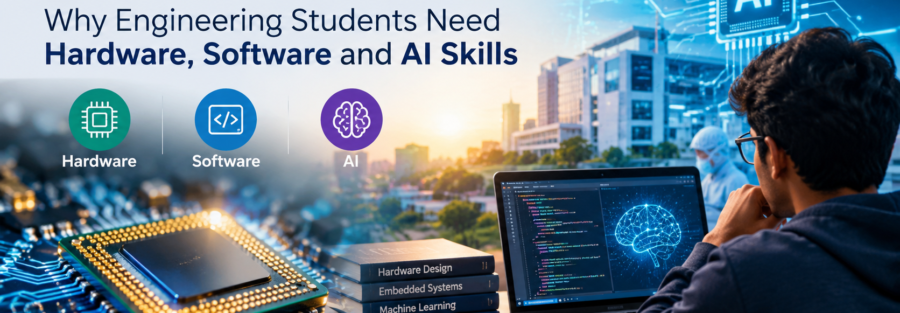
The future may not belong to hardware engineers or software engineers separately. It may belong to engineers who understand how hardware, software and AI work together.
Why Are Semiconductors Becoming So Important?
Every modern technology ecosystem depends on semiconductors.
From smartphones and electric vehicles to data centres, robotics, medical devices and AI systems, chips are at the heart of modern technology.
The rapid expansion of AI has increased the importance of specialised computing hardware. AI applications require powerful processors, memory, networking infrastructure and energy-efficient computing systems.
This creates opportunities beyond traditional software development.
Engineering graduates can potentially build careers in areas such as:
- Semiconductor design
- VLSI
- Chip verification
- Embedded systems
- Electronics design
- AI hardware
- Robotics
- Automotive electronics
- Aerospace systems
- Data-centre infrastructure
- Firmware development
- Hardware-software integration
India’s growing semiconductor ambitions are also creating interest in developing a larger pool of engineering talent with specialised hardware and electronics skills.
Is Computer Science Still a Good Engineering Choice?
Yes.
The rise of semiconductor engineering does not mean that Computer Science is becoming less important.
In fact, AI itself depends heavily on computer science.
Students pursuing CSE can explore areas such as:
- Artificial intelligence
- Machine learning
- Generative AI
- Data science
- Cloud computing
- Cybersecurity
- Software engineering
- AI application development
- Computer vision
- Natural language processing
- AI agents and automation
The bigger change is that computer science is increasingly connecting with other engineering disciplines.
An engineer working on an autonomous vehicle, for example, may need knowledge of software, AI, sensors, embedded systems and electronics.
That is where interdisciplinary engineering skills become valuable.
Why ECE Students Have New Opportunities in the AI Era
Electronics and Communication Engineering (ECE) is particularly well positioned at the intersection of hardware and software.
An ECE student can build knowledge across:
Electronics → Embedded Systems → Programming → AI → Robotics → Semiconductor Technology
This combination can open pathways into emerging technology sectors.
For example, an ECE graduate with programming and AI knowledge could work on:
- AI-enabled embedded devices
- Autonomous systems
- Robotics
- IoT
- Edge AI
- Semiconductor systems
- Automotive technology
- Drone technology
- Smart manufacturing
The growing convergence between AI and electronics means that students should not necessarily think of engineering branches as isolated career paths.
AI Is Not Only for Computer Science Students
One of the biggest misconceptions among engineering students is that AI is exclusively a CSE subject.
It is not.
AI can be applied across almost every engineering discipline.
Mechanical Engineering + AI
Mechanical engineers can use AI for:
- Predictive maintenance
- Digital twins
- Robotics
- Manufacturing optimisation
- Computer-aided engineering
- Industrial automation
Electrical Engineering + AI
AI can be applied to:
- Smart grids
- Energy management
- Power systems
- Fault detection
- Renewable energy forecasting
Electronics + AI
Electronics engineers can work with:
- Edge AI
- Embedded AI
- AI accelerators
- Sensors
- Robotics
- Semiconductor systems
Civil Engineering + AI
AI is increasingly relevant to:
- Smart cities
- Construction planning
- Infrastructure monitoring
- Traffic management
- Structural analysis
Aerospace Engineering + AI
AI can contribute to:
- Autonomous systems
- Flight optimisation
- Simulation
- Navigation
- Aircraft maintenance
The future engineer therefore needs to understand how AI can solve problems within their engineering domain.
The New Engineering Skill Set
A degree remains important, but the skills students build alongside their degree can make a major difference.
A future-ready engineering student should consider developing five major skill areas.
1. Programming Skills
Students should develop a strong foundation in programming.
Depending on their field, useful languages and technologies may include:
- Python
- C
- C++
- Java
- JavaScript
- SQL
Programming is becoming useful across engineering disciplines—not only software engineering.
2. Artificial Intelligence and Machine Learning
Engineering students should understand the fundamentals of:
- Machine learning
- Deep learning
- Generative AI
- Computer vision
- Natural language processing
- AI-assisted development
- AI applications
The goal is not necessarily to turn every engineering student into a machine-learning researcher.
The goal is to help students understand where and how AI can be applied to engineering problems.
3. Electronics and Hardware Understanding
For students interested in electronics, embedded systems or semiconductor careers, foundational knowledge of hardware is increasingly valuable.
Areas include:
- Digital electronics
- Microprocessors
- Microcontrollers
- Embedded systems
- VLSI
- Computer architecture
- Semiconductor fundamentals
- Sensors and IoT
This becomes particularly powerful when combined with AI and programming.
4. Analytical and Problem-Solving Skills
AI tools can generate code and assist with technical work.
But engineers still need to understand the problem.
Strong engineers must be able to:
Understand → Analyse → Design → Build → Test → Improve
This is why analytical thinking, mathematics, problem-solving and engineering fundamentals remain critical.
AI may help engineers work faster, but engineering judgement remains essential.
5. Interdisciplinary Thinking
This could become one of the most valuable skills for future engineers.
Consider a robotics project.
It may require:
Mechanical Engineering + Electronics + Programming + AI + Sensors + Control Systems
Similarly, an autonomous vehicle can involve:
Electrical Engineering + Electronics + Computer Science + AI + Embedded Systems + Mechanical Engineering
The boundaries between engineering disciplines are becoming increasingly interconnected.
AI + Chips: A New Career Ecosystem
The AI revolution is not limited to applications such as Chabot’s and AI assistants.
There is a much larger technology ecosystem underneath.
AI Applications
↓
AI Models
↓
Algorithms & Software
↓
Compilers & Systems
↓
Processors & Accelerators
↓
Semiconductors
↓
Electronics & Manufacturing
This means AI is creating opportunities across the entire technology stack.
Engineers can potentially enter the ecosystem from different directions depending on their education and interests.
What Should Engineering Students Do Before Graduation?
Students do not need to wait until their final year to prepare.
A simple four-year approach can help.
First Year: Build Foundations
Focus on:
- Programming
- Mathematics
- Engineering fundamentals
- Communication skills
- Basic technology awareness
Second Year: Explore
Start exploring:
- AI
- Machine learning
- Embedded systems
- Cloud
- Data science
- Electronics
- Robotics
Try different areas before choosing a specialisation.
Third Year: Build Projects
This is where learning should become practical.
Build projects that combine engineering with technology.
Examples:
- AI-based monitoring system
- Smart agriculture system
- Robotics project
- IoT device
- Computer vision application
- Predictive maintenance system
- Embedded AI project
Final Year: Become Industry-Ready
Focus on:
- Internships
- Advanced projects
- Industry certifications
- Technical interviews
- Communication
- Problem-solving
- Resume development
- Placement preparation
Your final-year project should ideally demonstrate what you can build, not simply what you studied.
What Does an AI-Ready Engineer Look Like?
An AI-ready engineer does not necessarily need to be an AI researcher.
Instead, they should be able to answer questions such as:
What problem am I solving?
Can AI help solve it?
What data is required?
Which technology should I use?
How will the system interact with hardware or software?
How do I test whether the solution works?
That combination of engineering fundamentals + technology skills + problem-solving ability can make graduates more adaptable.
The Future also Belongs to Hybrid Engineers
The biggest lesson from the AI and semiconductor boom is not that one engineering branch will replace another.
It is that the boundaries between disciplines are becoming less rigid.
A software engineer may need to understand hardware.
An electronics engineer may need programming and AI.
A mechanical engineer may work with robotics and machine learning.
A semiconductor engineer may work closely with AI systems.
A civil engineer may use computer vision and data analytics.
The engineer of the future is increasingly becoming a hybrid problem solver.
Conclusion: Engineering Is Changing—Students Should Change With It
AI and semiconductor growth is creating a broader engineering ecosystem in India.
Computer Science remains a strong pathway, but opportunities are also emerging across electronics, semiconductor technology, robotics, aerospace, embedded systems and other core engineering disciplines. The growing convergence of hardware, software and AI means students can benefit from developing skills beyond the boundaries of their chosen branch. (LinkedIn)
For today’s engineering students, the question should not simply be:
“Which engineering branch has the most jobs?”
A better question is:
“What combination of engineering knowledge and future skills will help me solve tomorrow’s problems?”
Because the next generation of engineers will not just use technology.
They will build it.