
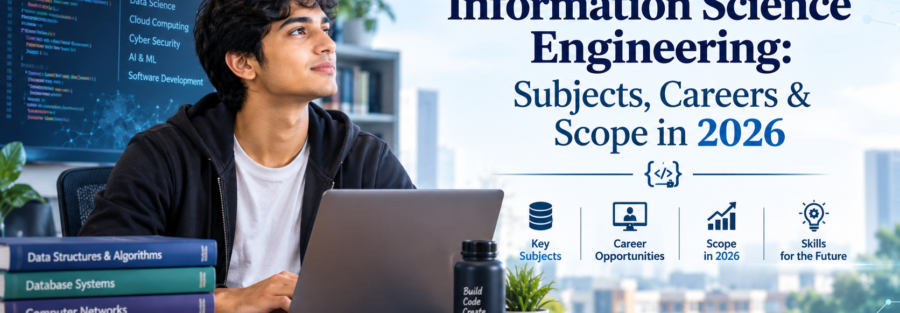
Choosing an engineering branch after Class 12 is one of the most important decisions students make. With courses such as Computer Science Engineering, Artificial Intelligence, Machine Learning, Data Science and Information Science Engineering now available, understanding the differences between these programs can be challenging.
One course that students often overlook is Information Science & Engineering (ISE).
So, what exactly is Information Science Engineering? What subjects do students study? What careers can they pursue? And is ISE still a good engineering choice in 2026?
This guide explains the course, its academic focus, career opportunities and the skills students can develop during their engineering journey.
What Is Information Science Engineering?
Information Science Engineering (ISE) is an engineering discipline focused on computing, information technology, software systems and the use of technology to manage, process and solve information-related problems.
The field sits within the broader computing and technology ecosystem.
Students can develop foundations in areas such as:
- Programming
- Data structures and algorithms
- Databases
- Software development
- Computer networks
- Information systems
- Web technologies
- Data management
- Artificial Intelligence
- Emerging digital technologies
The objective is not simply to learn programming languages.
Students are expected to develop problem-solving, computational thinking and technology skills that can be applied to real-world systems.
Why Is Information Science Engineering Relevant in 2026?
Almost every industry now depends on digital systems.
Businesses use technology to manage customers, analyse information, automate processes, and operate websites and applications, store data and make decisions.
This means technology professionals are required across sectors including:
- IT services
- Banking and financial services
- Healthcare
- E-commerce
- Manufacturing
- Telecommunications
- Education
- Logistics
- Cybersecurity
- Digital services
At the same time, emerging technologies such as AI, cloud computing and data analytics are changing the technology landscape.
For an ISE student, this creates an opportunity to build a strong computing foundation and then specialise according to their interests.
What Do You Study in Information Science Engineering?
The exact curriculum depends on the university and academic regulations, so students should always review the current syllabus of the institution they are considering.
However, Information Science Engineering generally involves a combination of computer science, software, information systems and engineering fundamentals.
Some important areas include:
1. Programming
Programming is one of the foundations of a technology career.
Students learn how to develop logical solutions to problems using programming languages and computational concepts.
Programming also becomes the foundation for areas such as:
- Software development
- Data science
- AI
- Machine learning
- Web development
- Automation
2. Data Structures and Algorithms
Students learn how information can be organised and how computational problems can be solved efficiently.
These concepts are particularly important for technical interviews and software-development careers.
3. Database Management
Modern applications depend heavily on data.
Students learn concepts related to storing, retrieving and managing information through database technologies.
Database knowledge can become useful in careers involving:
- Software development
- Data engineering
- Business applications
- Backend development
- Data analytics
4. Software Engineering
Information Science students can develop an understanding of how software systems are planned, developed, tested and maintained.
This provides a foundation for working on real-world software projects rather than focusing only on individual programming exercises.
5. Computer Networks
Networks allow computers, applications and systems to communicate.
Understanding networking fundamentals can support later learning in areas such as:
- Cloud computing
- Cybersecurity
- Distributed systems
- Enterprise IT
- Infrastructure
6. Information Systems
Information Science also focuses on how technology can be used to manage and process information within organisations.
This connects technical knowledge with real-world business and organisational requirements.
ISE vs CSE: Are They the Same?
This is one of the most common questions students ask.
ISE and CSE are closely related, but students should not assume they are identical.
Both can provide strong foundations in computing and technology, and graduates from either pathway can pursue software and technology careers.
The difference is primarily in the curriculum structure and areas of emphasis.
A simplified way of thinking about them is:
Computer Science Engineering
Typically provides broad exposure to:
- Computing
- Algorithms
- Software engineering
- Operating systems
- Networks
- Databases
- Cloud
- AI and emerging technologies
Information Science Engineering
Can combine:
- Programming
- Computing
- Information systems
- Databases
- Software technologies
- Data and information management
- Emerging technology applications
However, students should compare the actual curriculum of the colleges they are considering, rather than deciding solely based on the course name.
Can ISE Students Become Software Engineers?
Yes.
Information Science Engineering can provide students with computing and programming foundations that are relevant to software-development careers.
However, a degree alone does not guarantee a particular job.
Students interested in software engineering should additionally develop:
- Programming proficiency
- Data Structures & Algorithms
- Problem-solving
- Database skills
- Git and version control
- Software-development practices
- Web or application development
- Project experience
- Interview preparation
Building projects during college can help students demonstrate these skills to potential employers.
Can ISE Students Move Into AI and Data Science?
Yes.
Modern technology careers increasingly overlap.
An ISE student with a strong computing foundation can explore additional areas such as:
ISE → Programming → Data → AI/ML
Or
ISE → Software → Cloud → AI Applications
Or
ISE → Databases → Analytics → Data Science
This flexibility is one reason students should think about the skills they build during engineering, rather than looking only at the name of their degree.
ACET’s recent activities demonstrate this intersection. In February 2026, the institution conducted an AI & Innovation Sprints technical talk attended by third-year students from Information Science Engineering and AI & Machine Learning. The session focused on AI applications, rapid prototyping, industrial IoT, predictive analytics and smart automation.
Career Opportunities after Information Science Engineering
An ISE graduate can explore several technology-oriented career paths.
Software Engineer
Develops and maintains software applications and systems.
Full-Stack Developer
Works across frontend and backend components of applications.
Backend Developer
Builds the server-side components, APIs and databases that support applications.
Data Analyst
Uses data to identify patterns and provide insights that support decisions.
Database Engineer
Works with database architecture, performance and information management.
Cloud Engineer
Works with cloud infrastructure, applications and deployment environments.
DevOps Engineer
Works across software development and IT operations to improve development and deployment processes.
QA / Automation Engineer
Tests software applications and develops automated testing solutions.
Systems or Business Analyst
Works between technology and business requirements to help organisations design and improve systems.
AI / Machine Learning Roles
Students can also explore AI and Machine Learning after developing the required additional skills in mathematics, programming, data and ML technologies.
What Skills Should ISE Students Build?
The degree provides the academic foundation.
Students should use their four years to build practical and career-oriented skills.
Programming
Become comfortable with at least one programming language and understand programming fundamentals deeply.
Data Structures & Algorithms
Develop problem-solving skills and prepare for technical interviews.
Databases & SQL
Understand how applications store and work with information.
Web and Application Development
Build real applications rather than only completing classroom assignments.
Cloud Computing
Learn how modern applications are deployed and operated.
AI & Data
Understand emerging technologies and explore how they can be applied to software and information systems.
Communication
Technical skills need to be supported by the ability to explain ideas, collaborate and communicate effectively.
What Should an ISE Student Do During Each Year of Engineering?
A structured approach can make the four-year journey more productive.
First Year — Build the Foundation
Focus on:
- Programming
- Mathematics
- Problem-solving
- Engineering fundamentals
The goal should be to become comfortable with technology rather than rushing into every new tool.
Second Year — Build Technical Depth
Start focusing on:
- Data Structures
- Algorithms
- Databases
- Web technologies
- Software development
Begin building small projects.
Third Year — Explore Specialisations
This is a good stage to explore areas such as:
- AI
- Data Science
- Cloud
- Cybersecurity
- Full-stack development
- Automation
Students should also start looking for internships and industry exposure.
Fourth Year — Become Industry-Ready
Focus on:
- Major projects
- Internships
- Technical interviews
- Aptitude preparation
- Communication
- Resume development
- Placement preparation
The objective should be to graduate with evidence of your skills, not just a degree certificate.
Is Information Science Engineering Good for the Future?
The technology industry is constantly changing.
Some technologies that are highly popular today may change significantly over the next few years.
This makes adaptability increasingly important.
ISE can provide a computing-oriented foundation from which students can continue developing skills in areas such as:
Software + Data + Cloud + AI + Information Systems
The key is to avoid treating the degree as the final destination.
Instead:
Degree → Fundamentals → Projects → Specialisation → Industry Experience
This approach can help students remain adaptable as technology evolves.
Information Science Engineering at ACET
Aditya College of Engineering & Technology (ACET), Bengaluru currently lists Information Science & Engineering among its undergraduate engineering programs, alongside CSE, CSE (Artificial Intelligence), CSE (AI & Machine Learning), Data Science, AI & ML, AI & Data Science, ECE and Electronics & Computer Engineering.
ACET’s recent ISE activities also provide examples of student development beyond classroom learning.
The college recently highlighted its 5th-semester ISE academic toppers for 2025–26, with six students achieving SGPAs ranging from 8.79 to 9.63.
The ISE department is also represented in ACET’s Research & Development Cell, with Prof. Sumitha B. S listed as an ISE member.
ACET also reports innovation, hackathon and technology activities involving students across its engineering departments, giving students opportunities to work beyond conventional classroom learning.
Who Should Choose Information Science Engineering?
ISE can be worth considering if you:
- Enjoy computers and technology
- Like programming and problem-solving
- Want to explore software careers
- Are interested in databases and information systems
- Want flexibility to move into areas such as cloud, AI or data
- Prefer a computing-focused engineering pathway
You don’t need to know your exact technology career on day one.
Engineering can be a period of exploration.
The important thing is to build strong fundamentals first and then progressively specialise.
ISE vs CSE vs AI vs Data Science
With so many engineering programs available, students can easily become confused.
A simple starting point is:
| If you are primarily interested in… | Consider exploring |
| Broad computing & software | CSE |
| Computing + information systems | ISE |
| Artificial intelligence | AI / AIML |
| Data, analytics & predictive modelling | Data Science |
| AI + data together | AI & Data Science |
This is only a starting point. Students should compare the curriculum, faculty, laboratories, projects, internships and career support offered by individual institutions before making a decision.
Also Read: How students can become a AI Ready before Graduation.
Frequently Asked Questions
Is Information Science Engineering a good course?
ISE can be a strong option for students interested in computing, software, information systems and technology. The career opportunities ultimately depend on the skills, projects, internships and specialisation a student develops.
Is ISE the same as CSE?
No. They are closely related computing disciplines, but their curricula and emphasis can differ. Students should compare the actual curriculum of the colleges they are considering.
Can ISE students get software jobs?
Yes. Students with strong programming, DSA, software-development and project skills can pursue software-related careers.
Can ISE students enter AI and Data Science?
Yes. Students can build additional skills in Python, statistics, Machine Learning, data analysis and AI to explore these areas.
What are the career options after ISE?
Potential paths include software engineering, full-stack development, backend development, data analysis, database engineering, cloud, DevOps, QA automation and other technology roles.
Is ISE relevant in the age of AI?
Yes. AI is changing software and information systems, but computing fundamentals remain important. ISE students can build on their foundation by learning AI, data and cloud technologies.
Final Takeaway
Information Science Engineering is more than a degree focused on computers.
It can provide students with a foundation across programming, computing, information systems, databases and software technologies, while leaving room to explore emerging areas such as AI, data and cloud computing.
For students choosing an engineering branch in 2026, the most important question isn’t simply:
“Which branch has the best scope?”
A better question is:
“Which branch matches my interests, and what skills can I build from it?”
If you enjoy technology, programming and problem solving and want the flexibility to explore different areas of the digital world, Information Science Engineering can be a pathway worth considering.
At ACET, ISE is part of a broader portfolio of technology-focused engineering programs, giving students the opportunity to choose a pathway aligned with their interests and career goals.
Build the fundamentals. Explore technology. Create your future.