
Artificial Intelligence is changing the way businesses, industries and technology products work.
Behind many of these systems are three closely connected areas: Artificial Intelligence, Machine Learning and Data Science.
For students choosing an engineering course, this creates an important question:
Should you choose Data Science, Artificial Intelligence, Machine Learning or Computer Science?
The answer depends on your interests and the type of technology problems you want to solve.
While these fields overlap, they are not the same.
Understanding the difference can help students make a more informed engineering-course decision.
What Is Data Science?
Data Science is the discipline of using data, statistics, programming and analytical techniques to understand information and generate useful insights.
A Data Science student can work with data to answer questions such as:
- What is happening?
- Why is it happening?
- What could happen next?
- How can we make better decisions using data?
Data Science combines areas such as:
- Programming
- Statistics
- Mathematics
- Databases
- Data analysis
- Machine Learning
- Data visualization
- Artificial Intelligence
This makes Data Science particularly relevant in a world where organisations generate enormous amounts of digital information.
What Is Artificial Intelligence?
Artificial Intelligence focuses on building systems that can perform tasks that typically require human-like intelligence.
Examples include:
- Understanding language
- Recognising images
- Making predictions
- Recommending products
- Automating decisions
- Generating content
- Interacting with users
Modern AI applications can be found across healthcare, finance, manufacturing, automobiles, education, cybersecurity and many other industries.
AI therefore represents a broader technology area, with Machine Learning being one of the major approaches used to develop intelligent systems.
What Is Machine Learning?
Machine Learning is a branch of AI in which systems learn patterns from data and use those patterns to make predictions or decisions.
For example, a machine-learning model can be trained to:
- Predict customer behaviour
- Detect fraud
- Identify objects in images
- Recommend products
- Forecast demand
- Classify information
Machine Learning therefore sits at the intersection of data, algorithms and AI.
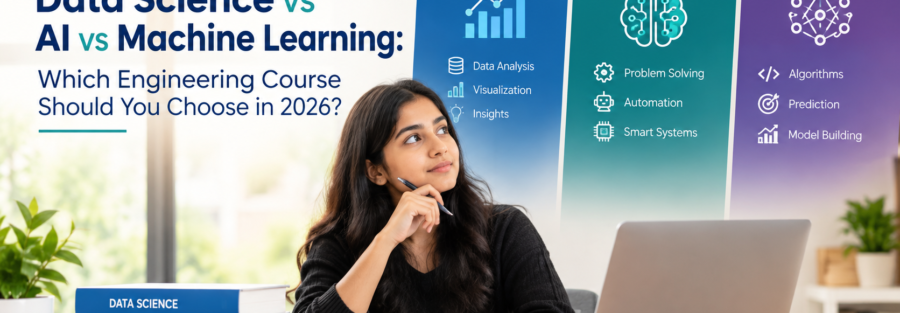
Data Science vs AI vs Machine Learning
A simple way to understand the relationship is:
Data Science
→ Collects, processes, analyses and interprets data
Machine Learning
→ Uses data and algorithms to learn patterns and make predictions
Artificial Intelligence
→ Builds systems capable of performing intelligent tasks
There is significant overlap between the three.
A Data Scientist may use Machine Learning.
A Machine Learning Engineer may build AI systems.
An AI application may depend on large amounts of data.
That is why students should look beyond course names and understand what they will actually learn.
What Do You Study in Data Science Engineering?
A Data Science engineering program can combine computing fundamentals with data-oriented skills.
Students can expect exposure to areas such as:
Programming
Programming provides the foundation for working with data and developing computational solutions.
Mathematics and Statistics
Statistics and mathematical reasoning are important for understanding data and building analytical models.
Databases
Students learn how information is stored, structured, retrieved and managed.
Data Analysis
Data needs to be cleaned, explored and interpreted before it can generate useful insights.
Machine Learning
Machine Learning allows students to move from simply analysing historical data to building predictive models.
Data Visualization
Large datasets become more useful when information can be communicated through meaningful visualisations and dashboards.
Artificial Intelligence
AI concepts can extend data-driven systems into intelligent applications.
The exact curriculum varies by institution and program.
What Do AI and Machine Learning Students Focus On?
AI and Machine Learning-focused programs generally place greater emphasis on developing intelligent systems.
Areas can include:
- Artificial Intelligence
- Machine Learning
- Deep Learning
- Natural Language Processing
- Computer Vision
- Intelligent systems
- Predictive modelling
- AI applications
For example, ACET’s AIML curriculum currently includes subjects such as Artificial Intelligence, Natural Language Processing and Machine Learning, alongside core computing subjects.
This illustrates why students should examine the actual curriculum instead of choosing a program based only on its title.
Data Science vs AI: Which Is Better?
There is no universally better option.
The better question is:
Which area matches your interests?
Data Science may suit you if you enjoy:
- Mathematics and statistics
- Working with datasets
- Finding patterns
- Data analysis
- Business intelligence
- Predictive analytics
- Turning information into insights
AI/Machine Learning may suit you if you enjoy:
- Programming
- Algorithms
- Intelligent systems
- Automation
- Neural networks
- Generative AI
- Computer vision
- Natural language processing
However, there is considerable overlap.
A Data Science student can move into Machine Learning.
An AI student can develop strong data skills.
A Computer Science student can specialise in either.
What about Computer Science Engineering?
Computer Science Engineering provides a broader computing foundation.
Students generally develop knowledge across areas such as:
- Programming
- Data Structures
- Algorithms
- Databases
- Operating Systems
- Computer Networks
- Software Engineering
- Cloud Computing
- AI and Machine Learning
This breadth can be useful for students who are interested in technology but have not yet decided on a specific specialisation.
The decision can therefore be viewed as:
| If you are interested in… | Consider |
| Broad software and computing | CSE |
| Data, statistics and analytics | Data Science |
| Intelligent systems | AI |
| Algorithms, predictive models and intelligent applications | AI & Machine Learning |
| Computing + AI + data together | AI & Data Science |
The choice should ultimately be based on the curriculum, your interests and the learning opportunities available at the institution.
Is Data Science Still Relevant in the Age of Generative AI?
Yes — but the role of Data Science is evolving.
Generative AI can produce text, images, code and other forms of content, but these systems still depend heavily on data.
Organisations need people who can:
- Understand datasets
- Analyse information
- Identify patterns
- Evaluate models
- Measure outcomes
- Build data pipelines
- Interpret AI-generated results
- Make data-driven decisions
Generative AI is therefore not necessarily replacing Data Science.
Instead, it is creating new ways for data professionals and engineers to work with information and intelligent systems.
What Careers Can You Explore After Data Science Engineering?
A Data Science graduate can potentially explore roles such as:
Data Analyst
Analyses data to identify trends and support business decisions.
Data Scientist
Uses statistics, programming and Machine Learning to extract insights and develop predictive models.
Machine Learning Engineer
Builds and deploys Machine Learning systems.
Data Engineer
Builds systems and pipelines for collecting, processing and managing data.
Business Intelligence Analyst
Uses data and reporting tools to support organisational decision-making.
AI/Analytics Engineer
Combines software, data and AI technologies to develop practical applications.
Data Consultant
Helps organisations use data to solve business and operational problems.
Career outcomes depend on the student’s technical skills, projects, internships, academic performance and industry exposure.
What Skills Should a Data Science Student Build?
A degree is only the starting point.
Students should gradually develop a combination of:
Programming
Learn programming fundamentals and become comfortable working with data.
SQL & Databases
Understand how real-world data is stored and retrieved.
Statistics
Build the mathematical foundation required for analysis and modelling.
Python
Develop practical skills for data analysis, Machine Learning and AI development.
Machine Learning
Learn how predictive models work and how they are evaluated.
Data Visualisation
Learn to communicate insights clearly.
Generative AI
Understand how modern AI systems can be incorporated into data workflows.
Communication
A technically strong solution is valuable only when you can explain what the data means and why it matters.
Projects Matter More Than Just Certificates
One of the best ways for an engineering student to understand Data Science is to build projects.
For example:
Beginner project
Analyse student performance data and identify trends.
Intermediate project
Build a model that predicts house prices or customer behaviour.
Advanced project
Develop a recommendation or predictive analytics system using a real-world dataset.
AI + Data Science project
Build an intelligent application that combines structured data with an AI model.
Projects allow students to demonstrate something that a certificate alone cannot:
the ability to solve a problem.
How Should You Choose a Data Science Engineering College?
Do not select a college simply because it advertises a “Data Science” course.
Look at:
1. Curriculum
Does the program provide a balance of computing, mathematics, statistics, data and AI?
2. Laboratories
Are students given access to computing infrastructure and practical learning environments?
3. Projects
Are students encouraged to build real applications?
4. Industry Exposure
Are there opportunities for internships, industry visits, workshops and interactions?
5. Faculty
Does the department have faculty with relevant academic and technical expertise?
6. Innovation
Are students encouraged to participate in research, competitions, innovation programs and technical events?
7. Career Support
Does the institution provide placement preparation and industry interaction?
Why Consider Data Science at Aditya College of Engineering & Technology?
Aditya College of Engineering & Technology offers Data Science as an undergraduate engineering program. The Data Science program with an intake of 60 students affiliated with Visvesvaraya Technological University (VTU). The department also describes dedicated computing facilities and opportunities for students to engage with emerging technologies.
ACET also offers related programs including CSE, CSE (Artificial Intelligence), CSE (Artificial Intelligence & Machine Learning), Artificial Intelligence & Machine Learning, and Artificial Intelligence & Data Science.
This gives students multiple pathways into the broader computing, AI and data ecosystem.
The institution also reports practical exposure through activities such as an industrial visit to the U. R. Rao Satellite Centre (ISRO) involving students from CSE, Data Science, AIML and AI&DS.
Data Science vs AI vs Machine Learning: Which One Should You Choose?
If you enjoy data, statistics and analytics, Data Science could be a strong choice.
If you are interested in intelligent systems and AI applications, consider AI.
If you are particularly interested in algorithms, predictive models and machine learning, an AIML-focused program may be suitable.
If you want broader computing flexibility, CSE can provide a strong foundation.
and if you’re interested in the intersection of computer science, AI and data, an AI & Data Science program may be worth considering.
The important thing is not to choose a course simply because a particular technology is trending.
Choose the course that matches the kind of problems you want to solve.
Final Takeaway
Data is becoming one of the most important foundations of modern technology.
AI systems need data.
Machine Learning learns from data.
Businesses use data to make decisions.
and engineers increasingly need the ability to work across these technologies.
For students entering engineering in 2026, the goal should therefore be bigger than simply earning a degree.
Learn the fundamentals. Build real projects. Work with data. Understand AI. Keep learning.
The technology will continue to change.
The ability to learn and apply it will remain valuable.
Thinking about career in Data Science?
Explore the Data Science Engineering program at Aditya College of Engineering & Technology, Bengaluru, and discover how you can build the technical foundation for a data-driven technology career.